
The Wells in Český Krumlov
Inner town
As in others towns, the wells were founded in Český Krumlov in the
same time as the town houses already from 13th century. The wells
were mostly situated in working part of house land. It was reason
of their frequent foulness. Contaminated well was served as outfall
pit and gradually was landed up. Some wells became extinct this way
already in 14th century. From that time the wells were insulated
and sometimes cleaned.
The method of well construction hadn't changed for centuries. The clay, stone or wood were used as building materials. The well age can be reliably determined only at wood ones, the age of others can be only estimated due to the archaeological discoveries.
The wells were important, and except the river, only one water resource for medieval citizens. They lost their importance with installation of public waterworks in Český Krumlov. The pipes were wooden and led the water to stone trunks and to the fountains. There was this kind of water supply in Český Krumlov already in Renaissance period. ( See History of Waterworks in Český Krumlov).
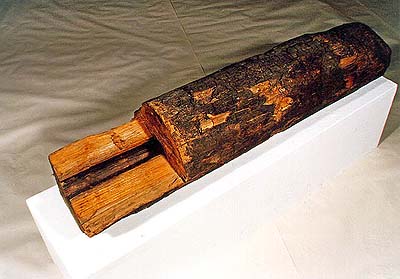
Until 1999, only nine non-landed up wells survived in inner town. Most of the wells haven't their own water source, water is drawing off there. Some of the wells are landed up and about others we can only dicker about. Many wells were discovered during house restorations in 90's. There were probably many more wells but there is preserved no mentions or documentation in the archives or in historical research reports.
Discovered wells have round shape and are generally stone or carved out in the rock, some ones with brick wall-coping or with stone backing. There is mostly clean water, with no smell and their pollution is not kept in mind of the renters as well. Laboratory analysis was proceeded at only one well. By the employee of District Authority in Český Krumlov, Mr. Hlaváček - the pollution of the carved wells is improbable even when Paper Mill Jihočeské papírny Větřní emited sewage water to the river Vltava. But other situation could be in the wells built in river alluvium.
Well-water is not usually used, finally some renters don't know about well in their house. Two wells implement interiors, one is occasionally used as fish-tank. Some wells are used only every so often. Water from only one is use as drinking water. The wells probably won't be used even in future. The well can't be connected to water supply - pertinent pollution or actually poisoning can strike whole the town. The carving of water pipes in historical objects probably discourages the house holders off using wells as sources of service water. (if somebody wants to use them as sources of drinking water he probably won't be able to reserve the protection of water source in built-up area). So the wells, that were important spring of drinking water for our predecessors, will remain unused.
List of well in particular houses in Český Krumlov:
Náměstí Svornosti No. 2
In June 1997 Dunka Company started preparing works for
reconstruction in the house cellars. Under the level of second
floor of cellars were discovered unknown place and also small room
in the rock which seems as a former well. It is landed up with
rubble and there were founded the beams and ceramic cullets.
In the same level of the left tract there is narrow corridor. Up to
ten meter the corridor is overhelmed and probably leads to Náměstí
Svornosti No. 3.
Náměstí Svornosti No. 3
The house owner supposes that well could be in the corner which is
markably more humid than other parts of cellars. Cellar floor is
made of concrete and there isn't evident existence of the
well.
Náměstí Svornosti No. 9, House At Blue
Horse
In cellar is situated approx. 8 meters deep well, water is reaching
to 3 meters and is clear. Fifteen years ago the well was covered
with plates and the cellar was modified to backstage of
delicatessen store.
Horní No. 145
In the cellar there was spring with reservoir carved in rock but it
was embed in concrete in 1973.
Horní No. 155
On the court there was stone, probably very deep, in 1976 still
covered with concrete board. The court is paved nowadays and nobody
knows about the well.
Horní No. 156
In back part of the cellar there is recess accessible from the
street where leads some steps to. The floor is flooded with wicked
water up to 10 cm.
Šatlavská No. 142
Stone well in the cellar is 5 meters deep and 1,5 m in diameter.
Water is clean and the owner used it as drinking water although the
analysis wasn't made. It isn't connected to water pipes. After
entire exhausting the well is full again after twelve hours. It is
probably supplied by the spring, well has outflow too which led to
the stone trunk in Masná Street in past times.
Radniční No. 27
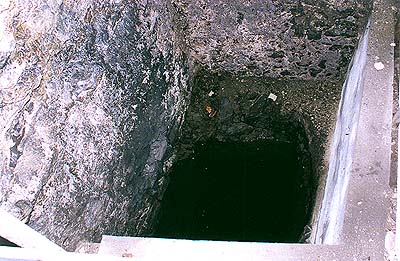
It is not perspicuous if there is well or instead trunk. It hasn't
round shape and its diameter is considerably smaller the others
(approx. 50 cm) and the place is wet. In depth of two meters it
continues beyond.
Masná No. 128
In the cellar can be founded well approx. one meter in diameter
with brick rim not higher then the floor level. Above the well is
round overlaid gap. The well was covered with plates during
reconstruction in spring 1999.
Dlouhá No. 30
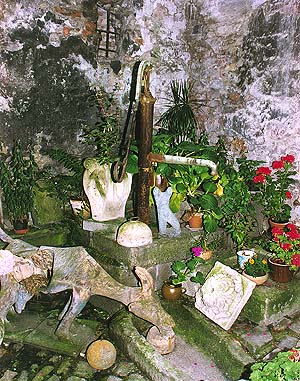
Seven meters deep well is situated on the court of today's
R.galerie.
Well is round supplemented with already functionless pump with
stone bed probably from the beginning of 19th century. Water mass
is five meter high. Through the court and the sitting-room is
leading stone trunk from well to street - probably from the first
quarter of 19th century.
Dlouhá No. 94
By the Former owner told that there should be landed-up well in the
house. Current owner don't know about it. The mention we can find
in historical research report of No. 95, page 4: the house No. 94
(former brewery) with the common well for both houses was sold to
Jindřich Schwingshartl also with one requirement: one half of well,
including using of pump, will belong to old malt house.
Dlouhá No. 96
Stone well in the cellar is landed-up and covered with board c. 60
x 60 cm. The house owners think that is isn't very old. Cellar
with the well is used as storage of Belarie Restaurant.
Panská No. 20
Filled up stone well is situated in the cellar under the yard. Its
rim is 40 cm higher then the floor. The cellar is flooded with
rainwater. Just above the well is square-shaped pit and its nose is
covered with stone board 2 x 1 m. The house keeper is planning to
restore it.
Dlouhá No. 32
Next one of filled-up wells was discovered in 1997 during house
reconstruction which was done by Vojenské stavby. The diameter is
about 1,2 m. Today the well is hidden under paving. In window arch
above the well is preserved iron loop which was probably used for
pulling up or dropping down of ewer.
Soukenická No. 33
Stone well in the cellar is partly landed-up, current depth is 1,35
m. Water is clear and it doesn't smell. Brick well crown is little
bit higher then the floor. About 25 cm of the crown is damaged (one
brick row is missing) and there is iron loop on the wall. Above the
well is square hole what is leading to the street and is covered.
There was window in past times. There is pipe leading from well
into the hole but it is not certain where it is finishing.
Sometimes the well water flooded the cellar. Ten years ago quite
often, recently not. The well is running dry in summer sometimes.
The water isn't used.
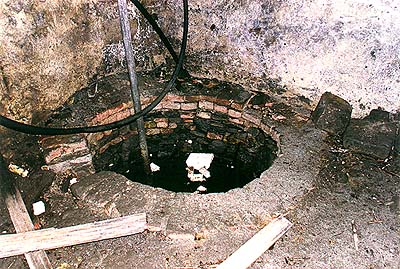
Soukenická No. 35
About the well we can read in tale 'House At Basilisk' in the
book by Helena Braunová - Český Krumlov Mystery. It is said that
this well was the biggest - it has diameter 4 meters and was very
deep. Current owner doesn't know anything about its existence. The
floor of the court is hightened, we can't foreclose that the well
was landed-up.
Soukenická No. 42
Approx. 3 meters deep stone well can be found in the cellar. Water
level is up to two meters. The bottom is rocky, coated by mud.
Water level is variable in accordance to river level. The
difference is about 30 cm. Water is not clear, sometimes bad smells
and perishes. After total discharging it is full in four hours.
Slantingly above the well is hole in cellar vault. The well was
discovered during house renovation in 1993. Well rim was originally
a little higher then the floor, during renovation it was heightened
upon 1 meter. As a protection against waterlogging there is a pump
with sensor and when the water level is too high, the water is
pumped to the sewerage system. The well in Bílá paní
Restaurant equipped with small fountain and the water is
circulating there. The water isn't used but by the chemical
analysis it can be used as service water.
Kájovská No. 54 (Na Louži)
The well in the cellar corner is partly carved and partly stone and
the rim is built from bricks. Above the well is hole covered with
stones. The well is 116 cm deep and the water is 50 cm deep and it
is clear and smell-less. Water level is variable and it is sucked
up twice a day. After pumping up the well is full in 1 - 1,5 hour.
It is supplied by strong ground spring. No analysis was made. The
cellars and other parts of the house are rented to Rybářská bašta
restaurant and the well is sometimes used as fish storage. In 1945
the water supply was out of order and the renters of neighbouring
Kájovská No. 69 used this well as a source of drinking water. The
well was tiled and maybe bigger in those times.
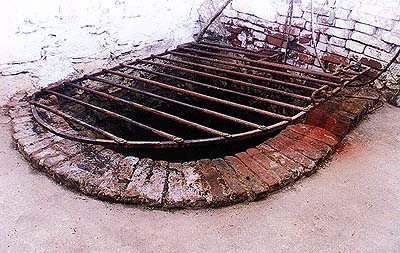
Široká No. 71
Landed-up well is situated in back street which is still
inaccessible. It is probably deep and wide and was used by Town
Brewery (the beer was brewed there even in 1948). It should be
uncovered in 1998 but wasn't. Its surroundings will be planted
with trees and flowers. The owner (Egon Schiele Centrum) got to
know about the well from son of last maltster - Mr. Marx who is 90
and lives in Linz.
Široká No. 72
This well was hidden under stones in the ground floor. It is 4
meter deep including 75 cm of brick rim. The diameter is one meter.
Water mass is two meter high. After total exhausting it is filled
in few hours again. Water is used for watering of the garden.
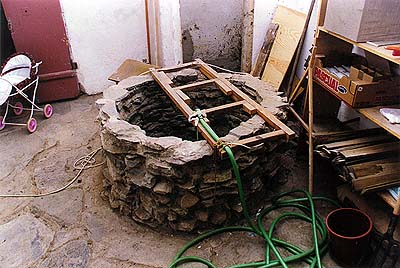
Hradební No. 60
Landed-up well was perceptible from wood-sheds near house. After
reconstruction in 1998, the well rim can't be seen in newly formed
garden.
Kájovská No. 63
The cellar well is 2 meters deep, water mass was 1,5 m high. The
bottom was covered with boulders but later it was heighten so the
water mass is a meter now. For masonry works were used stones and
clay. The water level is still with no dependence on river level.
After total exhaustion the well is full after a half of day. No
analysis was made. The water is clear and with no smell. There is
preserved no mentions about the well, so it is presumable, by the
character of well and cellar, that it was built in the same time as
the house which is first time mentioned in 14th century.
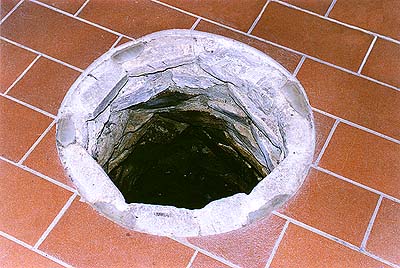
The house was owned by tanners so it supposed that the water was used for their craft. The well was discovered in 1996 during reconstruction and it was hiden under some layers of paving and concrete and finally covered with big stone. Above the well was hole and it is on the imaginary axis as the well. It was probably used for spooning out of water with the ewer. Water was used during reconstruction for building demands. It has decorative function nowadays. It is accessory of the shop and it is covered with glass and the water isn't used.
Kájovská No. 68
By the stories of denizens there is well with water in the cellars.
It was denied by contemporary house owners.
(ok)
Further information:
History of Waterworks in Český Krumlov
Fountains and Watering Places in Český Krumlov
Fountain on the Square in Český Krumlov
Castle
Waterworks
At the
Waterfountain
The
Cascade Fountain
Click-sensitive
map of Český Krumlov