

History of Hunting and Gamekeeping in the Region of Český Krumlov
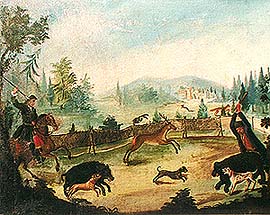 The development of
hunting and game management in the region of Český Krumlov had been
a part of forestry for a long time and had a traditionally high
level of quality. In the past many significant foresters and
gamekeepers used to work in this region, well known names are for
example John, Matz, Rosenauer, Schönauer, Heske, Duschek and
others.
The development of
hunting and game management in the region of Český Krumlov had been
a part of forestry for a long time and had a traditionally high
level of quality. In the past many significant foresters and
gamekeepers used to work in this region, well known names are for
example John, Matz, Rosenauer, Schönauer, Heske, Duschek and
others.
In the past the whole territory was covered by the original forest with various species of animals. The ancient history of hunting is documented by the finds in the cave of Dobrkovice, where bones of prehistoric as well as contemporary animals were found. Among them were those of hyena, wolf, fox, bear, mammoth, horse, bison, deer, reindeer, cat, badger and hare. Hunting for food in those times had little in common with the gamekeeping as we know it today. The gamekeeping evolved only in the Middle Ages.
A written order not to shoot small game is the first documented fact of gamekeeping in the region of Český Krumlov. It was given by Johann von Rosenberg at the end of the 15th century and included estates of Český Krumlov, Rožmberk and the estates of the monastery in Vyšší Brod. Until the early New Age, according to the chronicler Václav Březan, who worked for the last Rosenbergs in the second half of the 16th century, hunting was considered an entertainment. The Early Middle Ages brought a gradual change in the forests themselves. The forests were both cleared to gain agricultural land, the wood was used as building material and fuel and also for resin and production of charcoal and potassium. Since the 15th century they helped the development of the glass works. The main use of the forests was originated mostly towards to satisfaction of the need of the estates and the serfs. They used also the forest grass and stumps.
|
|
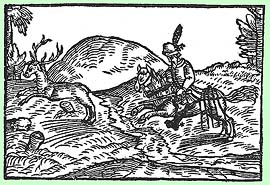
In the 17th century, hunting had become more popular than ever, the middle of the century with its hunting music, trophies, grand hunting festivals and great hunts for famous people earned the name the golden age of gamekeeping. At this time begins the recreation of patrons of gamekeeping - Saint Hubert and Saint Eustach. Its originator was earl Špork and was followed by other members of the nobility in the southern part of Bohemia. With the modern economical thinking forestry started to gain the upper hand over hunting in the 18th century. It lead to the decrease of game which was considered at this time to be a danger to the forests and agriculture and so the production of game was pushed behind.
According to the foresters the character of the forests had changed considerably during centuries in this region "although the lords of Rosenberg were always devoted worshipers of Lověna, the goddess of hunting and if they were not occupied by wars and feuds, they were keen to pick up a bugle-horn and a spear. But the results of the hunts in the deep and treacherous woods in the region of Český Krumlov did not show much success as the inclement weather, lots of snow and a lack of protection and care for the game did not help the inducement to increase the number of game". This citation comes from the "Description of the Krumlov Estate", in 1898.
Between the 12th and the 15th centuries the area of Český Krumlov right up to the bordering mountains contained a whole amount of birds of prey and predatory animals. There were eagles, hawks, brown bears, wolves, wild cats and lynx. The lynx has been placed in Šumava by man again a couple of years ago. Wild boars were very plentiful at that time in comparison to today's situation.
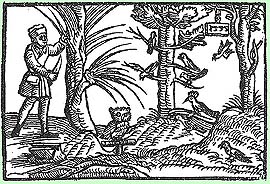
Archive documents tell us a lot about the forestry in the region of Český Krumlov. Apart from the above mentioned prohibition of Jan von Rosenberg, there is another edict "collecting of royal taxes and a right to hunt in the forests belonging to monastery, to kill various game and cut the timber for building and burning in the Krumlov castle". This right was given to Wok von Rosenberg in 1493 for the commodities of Zlatá Koruna. There is a mention in other documents about the right to take out young eagle-owls from the nests for hunting purposes on the steep banks of the Vltava river, in the hunting grounds of Bory near Křemže. Other reports from the beginning of the 16th century document bird catching (catching of singing birds on bird-lime or in nets) around the town of Český Krumlov.
Already in 1528 there was an arrangement between Jan von Rosenberg and the neighbouring noblemen to protect hares. This agreement shows the beginning of co-operation among neighbours to protect game. The Register of Marked Marten Paths (trap lines) for the region of Český Krumlov from 1553 is unique in the whole Europe. It describes all rented marten paths. Marten furs were traditionally very valuable and in the early times served even as a legal tender.
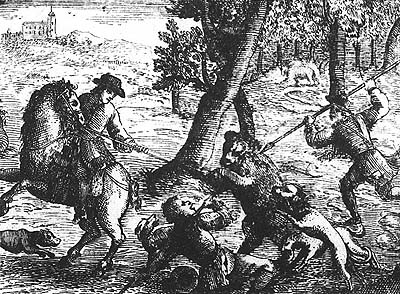
Other reports concerning forestry came from the time of the penultimate Rosenberg Wilhelm, whose regent was Jakub Krčín z Jelčan. By his instructions the village mayors were supposed to report to Krumlov any breach in the law by hunting certain species of game and the poachers were strictly persecuted. During the reign of the last Rosenbergs a set of rules had been established to determine duties, tasks and rights of the forestry personnel. Hunting at the time was mostly the privilege of nobility and it is interesting to note that at the court of Peter Wok von Rosenberg some ladies were also participating - they used cross-bows. One of the favourite entertainment was target shooting from cross-bows and guns - even with some betting. On the Rosenberg estates bear hunts were also organised, above all in the woods surrounding Hluboká and Veselí. The wildest bears
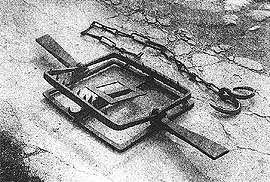 were selected for the
hunts. They were kept in the moat of Český Krumlov and came
originally from the woods around Plešné lake in Šumava. The bears
have been kept in the moat of Český Krumlov since 1558.
were selected for the
hunts. They were kept in the moat of Český Krumlov and came
originally from the woods around Plešné lake in Šumava. The bears
have been kept in the moat of Český Krumlov since 1558.
To improve the hunting entertainment, the first deer park was founded by Wilhelm von Rosenberg in 1555 near Český Krumlov. This Tendlgarten, which extended from the northern part of the castle to the village of Dobrkovice, contained deer as well as roebucks. Today's area of the park and gardens directly under the castle - in the so-called Jelení příkop (Deer Moat) - used to be a large pond with an island in the middle. 106 roebucks still lived in the deer garden in 1784. ( Deer Park in Český Krumlov). The whole deer garden was destroyed by the big flood on July 14, 1848 - all the animals were drowned.
Peter Wok von Rosenberg established a new protected area near Nový Dvůr Chvalšinský (today Červený Dvůr) in 1598. It was designed for breeding of pheasants, partridges and quails. A pheasant hatchery was established here in 1687. There were not only pheasants but also exotic birds and animals, beavers, Bengal deer "tripolitánská" sheep, ibex and different species of geese. The hatchery lasted until 1834 when it was closed for the lack of use.
Interesting reports concerning gamekeeping come from the times when the Rosenbergs were replaced by other families of nobility. In 1608 Herman Apfelbaum pointed out the possibility of hunting wolves in the surrounding woods. It was not long after the sale of the Český Krumlov estates to the emperor Rudolf II. von Habsburg. The region was divided into 11 hunting sections headed by gamekeepers in 1603. The forest inspector with his clerk kept office in Český Krumlov, and they were given specific instructions - quite modern for that time. Command was issued in 1656 on how to prevent the theft of wood and other points concerning forestry. Part of the document cited about the duty of the village masters, to inform population as there would be no excuses on this account of not knowing the law. According to the documents from 1681 all the Eggenberg estates were under the administration of one "head gamekeeper". He was the superior of the gamekeeper and his helper in Český Krumlov, there were 11 gamekeepers in the Krumlov region, a gamekeeper for the woods of
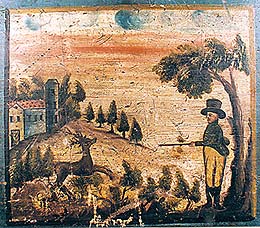 the Prachatice estate and
other employees - gamekeeper for bird catching with a helper, a
worker taking care of canvases and nets, and two men with a helper
in charge of the hunting dogs. According to bookkeeping documents,
gamekeeping was still the main part of the all forestry management.
The hunting of bears was still common in the region, by the
beginning of the 18th century - and wolves, lynx, wild cats were
plentiful till the end of the 18th century. In the last five years
of the 18th century, 65 eagles were shot.
the Prachatice estate and
other employees - gamekeeper for bird catching with a helper, a
worker taking care of canvases and nets, and two men with a helper
in charge of the hunting dogs. According to bookkeeping documents,
gamekeeping was still the main part of the all forestry management.
The hunting of bears was still common in the region, by the
beginning of the 18th century - and wolves, lynx, wild cats were
plentiful till the end of the 18th century. In the last five years
of the 18th century, 65 eagles were shot.
Gamekeeping in the region of Český Krumlov changed for the better during the reign of the Schwarzenbergs. Johann Adolf zu Schwarzenberg issued an order to regulate gamekeeping in 1663. Only those gamekeepers, whose task it is to kill wolves, foxes, martens, beavers and other smaller animals of prey are allowed to carry guns. Also Adam František zu Schwarzenberg with his wife Eleonora Amálie, born of Lobkovic, were known for their interest in gamekeeping and under their wing the gamekeeping flourished. (Imperial Hunt)
The decree from 1722 by Franz zu Schwarzenberg contains the following rule "...stewards should take care of fawns if they were brought to them by a gamekeeper". There was another rule in place at the beginning of the 18th century - to build up new forest roads, cut lines and paths and clean the glades after wind-damages to the trees - namely in the Blanský forest. At the same time there were thoughts about regulating hunting - there had been complaints since the end of the 17th century, indicating severe losses in some species. For example in 1719 the game inspector for the Český Krumlov estate wrote "the main hindrance for deer breeding is excessive hunting and a lack of right habitat. The deer is disturbed by the grazing cattle in the woods and by cutting the thickets, there are not suitable enough places for the game".
The introduction of the forest regulations in 1715 played a great role in the progress of gamekeeping. It was issued by duke Adam Franz zu Schwarzenberg. Since then the vermin had been hunted, the overall hunting care got better and it caused a great increase in the game numbers. Adam Franz was not only a good gamekeeper but also a farmer. He often checked on the condition of forests and gamekeeping himself. His wife Eleonora was an enthusiastic hunter too which is evident by her many trophies. During their reign there had been a marked increase in deer population, the wolf fences were erected and the strict rules were given, how to read animal tracks in forest snow, negligent gamekeepers were punished and the poachers were persecuted. During the reign of Adam Franz and Eleonora the so-called "huts with bait" were built on many places of Blanský forest, which was a kind of covers used to hunt by bait (usually dead horses or sheep were used). On the other hand, meadows and fields for the deer were established - and even rutting places for stags. To facilitate the hunts, passes and roads were made in the woods and great care was being taken to clean all the "hunting grounds" from the leftovers from tree felling. The game was hunted even by using canvases and nets in the thick growth. Only later all kinds of watch towers came to use which were constructed at the most suitable places. Duke Adam Franz also paid special attention to woodcocks.
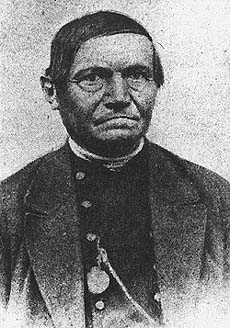 A significant reduction
in the deer population came by the end of the 18th century. The
reasons were various, for one, the deer caused severe damage to
crops and another reason was the ever increasing number of
poachers. Organised groups of poachers from Bavaria didn't contain
their activities to the close proximity of the border, but spread
even to the woods around Kleť. A game inspector from Český Krumlov,
Václav Feldegg sent a special delegation to the bishop in Passau to
negotiate some steps against poaching. The result was handing over
some of the most notorious poachers to the Czech authorities and
sending soldiers to guard the most used border crossings. In 1848
in the hunting ground of Borová the last stag was shot and only
after World Word II the deer reappeared again in the Blanský forest
from the neighbouring woods belonging to the army. In the second
half of the 18th century the wild boar was hunted to extinction in
the whole region of Český Krumlov. It is interesting to note that
in 1726 there was a slaughter house built for wolves, at one part
of the public forest of Chvalšiny near Hejdlov. Since that year a
very detailed record had been kept, documenting the number of shot
animals on the land of the Český Krumlov estate. This record
continued until the confiscation of private property of the
Schwarzenbergs in 1945. Data kept by the generations of gamekeepers
are a unique source of information about the history of game
population in the region of Český Krumlov. The originators of the
record divided the game into several useful categories - fur
animals (deer, buck, roebuck, wild boar, hare and beaver) and
feathered ( woodcocks, black grouse, grouse, pheasants, partridge,
wild geese and ducks, coots and big and small snipe, animals of
prey - fur animals (bears, wolves, lynx, wild cats, otters, foxes,
martins, skunks, weasels and squirrels) and feathered (eagles,
great owls, cranes, herons, hawks and crows).
A significant reduction
in the deer population came by the end of the 18th century. The
reasons were various, for one, the deer caused severe damage to
crops and another reason was the ever increasing number of
poachers. Organised groups of poachers from Bavaria didn't contain
their activities to the close proximity of the border, but spread
even to the woods around Kleť. A game inspector from Český Krumlov,
Václav Feldegg sent a special delegation to the bishop in Passau to
negotiate some steps against poaching. The result was handing over
some of the most notorious poachers to the Czech authorities and
sending soldiers to guard the most used border crossings. In 1848
in the hunting ground of Borová the last stag was shot and only
after World Word II the deer reappeared again in the Blanský forest
from the neighbouring woods belonging to the army. In the second
half of the 18th century the wild boar was hunted to extinction in
the whole region of Český Krumlov. It is interesting to note that
in 1726 there was a slaughter house built for wolves, at one part
of the public forest of Chvalšiny near Hejdlov. Since that year a
very detailed record had been kept, documenting the number of shot
animals on the land of the Český Krumlov estate. This record
continued until the confiscation of private property of the
Schwarzenbergs in 1945. Data kept by the generations of gamekeepers
are a unique source of information about the history of game
population in the region of Český Krumlov. The originators of the
record divided the game into several useful categories - fur
animals (deer, buck, roebuck, wild boar, hare and beaver) and
feathered ( woodcocks, black grouse, grouse, pheasants, partridge,
wild geese and ducks, coots and big and small snipe, animals of
prey - fur animals (bears, wolves, lynx, wild cats, otters, foxes,
martins, skunks, weasels and squirrels) and feathered (eagles,
great owls, cranes, herons, hawks and crows).
The data about bears, on the estate of Český Krumlov are well known. In the later years, they have lived here only sporadically - mostly in the "upper" hunting grounds in Šumava. The legendary "last bear of Šumava" was shot in 1856 in Želnava. The last wolf was shot in 1795 and the last two lynx in 1802 - all in the Šumava region. The last wild cat was only shot on Kleť in 1836.
After the disappearance of the large animals and the limiting the poaching, the counts of deer were quickly rising. The same is true about the birds of prey - when they collapsed the population of woodcocks and black grouses increased - especially after big storms of 1870 to 1875 when many trees were blown down. After that, the draining of marshes and cleaning of the fallen trees to make meadows brought the decrease of those birds again.
Social changes of 1848 had an effect on gamekeeping too. The feudal forced labour was abolished - also for all gamekeeping. The serfdom forced labour was abolished , also for all gamekeeping, and the damages caused by animals had to be paid by the owners of hunting grounds. Nevertheless hunting remained the domain of the owners of forests and agricultural lands. Long after the year 1848 in spite of the fact that the exclusive right to hunt for nobility was abolished by the emperor's edict on March 7, 1849. The land law from 1866 abolished the remaining rights for exclusive hunting by the gentry and a new system of common hunting ground has been established. It led to disputes between the nobility and their serfs. The farmers' hunts were looked upon with contempt, but it is true the new hunters usually killed off all the animals and used the hunts as a means for confrontation with former masters.
Step-by-step the economical view started to gain the upper hand in forestry as well as in agriculture. Some animals were considered harmful and were therefore being eradicated. The following development of gamekeeping has been strongly connected with the land reform of 1919. Another corrosion in gamekeeping came with the Nazi Protectorate of Bohemia and Moravia, where the new boarder often divided the big estates and with it the network of gamekeeping arrangements. At the same time, strong steps were taken against gamekeeping and even against gamekeepers themselves.
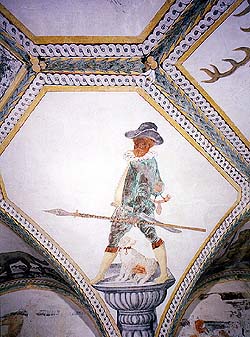
|
|
The evolution of gamekeeping and forestry has been continuing into the present. For example one of the most debated problems today is the presence of the bark beetle in the National Park of Šumava - and how to handle the damage. Not long ago serious discussions came up in the Lynx project. Between 1982 -1987 12 lynx were introduced into the Šumava National Park. The project has been so successful, that the lynx is now common in many regions - even in the Blanský forest and it has not been decided how to regulate the spreading to places which were not included in the project. A similar situation appeared in the fifties and sixties, this time with the deer. The damage to the trees was so severe that a significant reduction in the deer population had to be implemented. On the other hand - right now there is a trend to increase the numbers again, because there are fewer hunting grounds and the damage done by some chemicals used in agriculture. The same fate is shared by hares - they had not been hunted even before the ban was announced in solidarity with the hunters of Moravia ( many of whose hunting grounds were flooded).
Gamekeeping together with forests in the region of Český Krumlov has an interesting history. As in any human endeavour many errors have been made and these were gradually corrected by our predecessors. It was one of the reasons why the game populations fluctuated. But to give the older generations their due, we have to admire their regard for nature and its gifts. This can not be said about the last war period and the following years, when not every gamekeeper followed the old traditions and not all hunting grounds were managed by the old time proven principles. In spite of this the natural habitat surrounding of Český Krumlov is still intact and presents a richness which hasn't been fully realised. It's up to the new hunters and gamekeepers to resist the temptation of the market economy -and consider the gamekeeping only from the economical point of view. Gamekeeping is a long term co-operation with living nature that requires a lot of common sense and feeling - as well as much expert knowledge.
(jn)