
History of Pharmacies in Český Krumlov
Seeking out healing matrials and providing curatives to the sick is perhaps as old as humanity itself, as pharmacy closely coincides with the development and evolution of the natural sciences and recognition of the natural surroundings. The oldest pharmacies in Bohemia were first mentioned in the 14th century, and the first written mention of a pharmacist in Český Krumlov is from 1568.
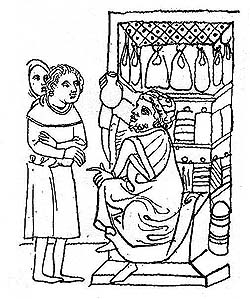
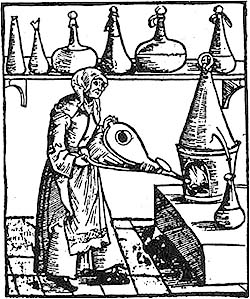
We may say that every pharmacy in the past consisted of at least two rooms - the shop where medicines were sold, and the laboratory with a considerable amount of wooden, pewter, copper, clay, porcelain, and glass vessels and large mortars where raw materials were crushed to make drugs. Pharmacies, in comparison with other shops, were always noted for their remarkable cleanliness and orderly shelves with distinguishing vessels, pots, jugs, pots, ladles, measurers, and porcelain, paper, and wooden boxes which sat on richly carved and guilded shelves. In the center of the pharmacy there would be a long shop counter (tára) with pharmaceutical scales and mortars. Near the counter stood sacks of healing herbs and spices. In several easily-accessible shelves and compartments other raw materials were stored - roots, seeds, dried fruits and flowers, coloring agents, incense, wax, honey, almonds, gingerbread, tree bark, bones, fats, lards, and poisons. Directly in the pharmacy and in the adjacent laboratory the apothecare produced various mixes, balms, oils, tinctures, and ointments. In addition to this classic array of pharmaceuticals, the apothecare produced several other things of a more luxurious character - sweets, wafers, preserves, marcipan, colors, wax products, candles, balsams, poisons, soaps, perfumes, and liquors.
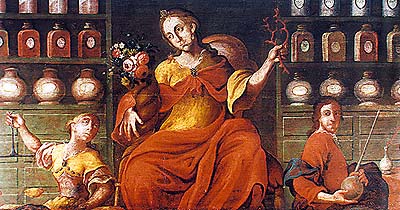
Pharmacies in the town were most often equipped by the nobility, town offices, or church institutions, thus allowing the apothecare the proper facilities in accordance with his guild. Due to their notable responsibility and indispensibility, they often enjoyed privileged positions among the respected members of the town. There were three pharmacies in Český Krumlov - municipal, castle, and Jesuit.
The first mention of a pharmacist in Český Krumlov comes from the year 1568, when the apothecary Hans Gunstätter bought a house on Radniční Street. In 1620 a pharmacy was located in the rear part of the Town Hall building (Náměstí Svornosti no. 1), which was used up until 1637 by Gunstätter´s successors Kristián Xaver Hable and Basisius Frank. Frank lost his pharmacist´s license in 1720, as he had been operating kind of a doctor´s practice since 1710, a task for which he was unauthorized and lacked the required education. The city pharmacy was closed for four years until 1724, when on the 22nd of March Franz Alois Magg bought the pharmacy from the town for 250 gold pieces. He left Krumlov after four years, because "he cannot make a living here, because in Krumlov people will not be ill." From 1728 - 1729 the prince Adam Franz von Schwarzenberg suggested several times that the city close its pharmacy down, because a castle pharmacy was already in operation on Latrán (Latrán no. 66). The Schwarzenberg aristocrat ultimately ended up reinstalling the equipment of the town pharmacy to the Castle´s, and the same happened a bit later to the discontinued Jesuit pharmacy.
Around 1720 the town pharmacy moved from the town hall to a house near the square (Panská no. 22), which is still evidenced by the painted decorations with the figures of Aisklépia and Hygie, or the eagles with the inscription OFICINA SANITATIS on the ground floor where the shop was. In 1851 the pharmacy moved again to the house on the square (Panská no. 16), where with intermittent pauses the pharmacy has functioned up until today.
|
|
The existence of a Jesuit pharmacy in the town is associated of course with the activities of the Jesuit Order, and was originally located in the complex of buildings of the Jesuit college at Horní no. 154, built on orders of Wilhelm von Rosenberg in 1586-1588 from the plans of the Italian builder Baldassar Maggi from Arogno. The first preserved written information about the Jesuit pharmacy comes from 1640, and though the exact year of its beginning isn´t clear, it is estimated that the pharmacy began to function shortly after the year 1600. After the order was dissolved in 1773, all the furnishings of the pharmacy were bought by the Schwarzenbergs for 3000 pieces of gold and transferred to the Castle, even though the town council wanted it as well for its own pharmacy. There wasn´t much interest among the town residents in the Castle pharmacy, and its furnishings were moved to the so-called Roman Chamber, where it joined a collection of interesting memorabalia and curiosities. The Baroque pharmacy ended up in the hands of the Český Krumlov museum in 1952 as the only preserved set of its kind.
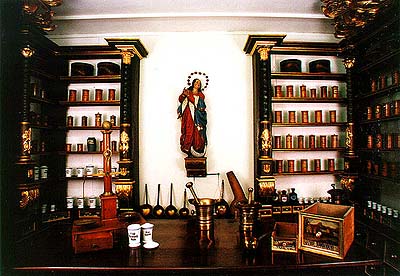
The basis of the Baroque Pharmacy is the equipped Baroque shop which consists of richly engraved, painted, and guilded corner shelving from spruce or pine wood with shelves and 70 drawers with Baroque border decorations and Latin inscriptions (signatura). The Baroque Pharmacy also has remarkable painted and engraved ornamentation, as above the shelving are two oval pictures of saints - St. Jan Nepomuk and St. Pantaleon in richly engraved and guilded frames, plus a centrally placed statuette of the Virgin Mary, plus a hanging crest which is ascribed to the South Bohemian painter František Jakub Prokyš. The basic furnishings of the pharmacy consist of about two hundred detailed pieces - mortars, pots, ladles, glass, wood, stone or porcelain boxes, bottles, and stands which come from the 17 - 19th century. One interesting item is the iron "wafery" (oplatnice), which was used to make round wafers.
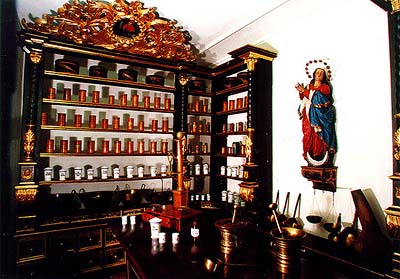
The entire set of the Baroque Pharmacy was costly restored in the 1970´s and today is part of the permanent exhibition of the Regional National History Museum in Český Krumlov. This set ranks among the world´s truly admired collection items, as it is a unique preserved pharmaceutical Baroque shop, and there aren´t many of these left to us anymore.
(mj)